Why This Region?
Eastern Nepal is changing fast. New hydropower investment is reshaping the Taplejung district, bringing roads, infrastructure and industry. But the opportunity is spreading unevenly. In the remote valleys and mountain villages of Phaktanglung municipality, children are being left behind.
Our baseline study found:
We know that Children who fall behind almost never catch up. That’s why childhood is where the biggest opportunity lies, and where the right investment changes everything.
In far Eastern Nepal, children walk up to three hours to reach school. Floods, landslides and heavy weather can cut off entire communities for weeks. And for many families, keeping food on the table means pulling their kids out of class to work the fields and feed the animals.
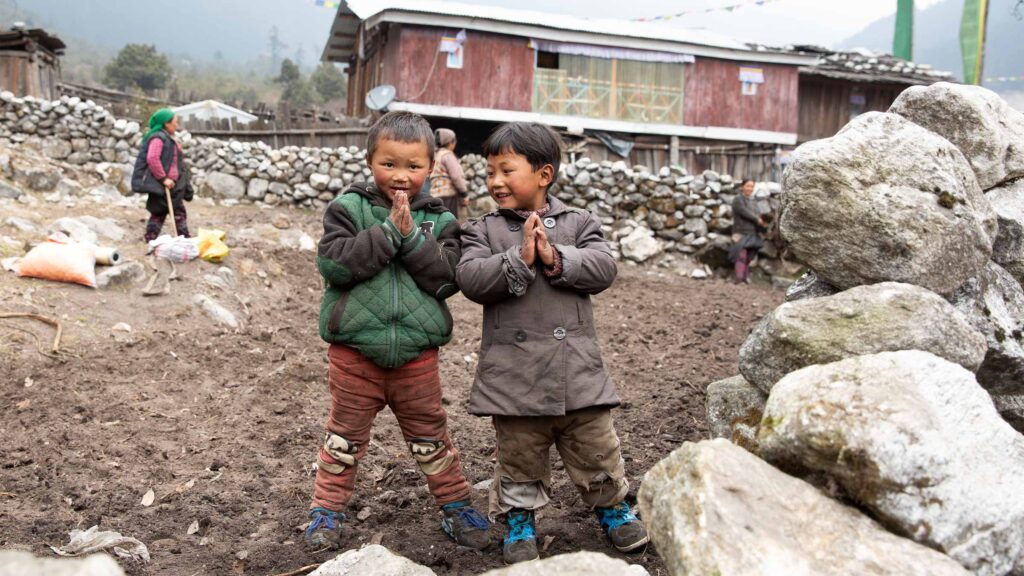
The Phaktanglung Region is one of the hardest parts of Nepal to reach.
What We’ve learned
HDFA’s work in Eastern Nepal started with a promise to one village.
In Ghunsa, at 3,400 metres, we helped a community transform a single cold classroom into a model school with 100% attendance. The village now runs its own school, hostel and health post.
In Hellok, we partnered with local leaders and Almost Heaven Farms to strengthen teaching, build a biofertiliser factory, train over 100 farmers in orchard management and soil health, and help six women launch micro-enterprises with municipal co-funding.
Across the municipality, an agricultural training centre is building local capacity. All nine secondary school principals recently visited three of Nepal’s best community schools to see what’s possible, and came back with action plans for their own.
Eastern Nepal Rising builds directly on these successes — but looks at the entire municipality.
The Project
Eastern Nepal Rising brings everything HDFA has learned over the past decade into one integrated plan across the Phaktanglung municipality.
An education pilot with PHASE Nepal is running in two schools, focused on teaching quality, early childhood development and getting parents more involved. The Hellok health unit is serving 120 patients a month with HDFA providing the top-up medicines and supplies that aren’t covered by government. Farmers are adopting new techniques, the biofertiliser factory is up and running, women are launching businesses, and a local agricultural training centre is building the expertise to keep it all going without us.
On the ground, HDFA’s local coordinator Mingma Dandu Sherpa connects the dots across the region, working with villages, schools, local government and partners to keep everything moving and unlock opportunities for communities that would otherwise be overlooked.
But this is bigger than any single program. Our vision is an entire mountain municipality where every stakeholder is pulling in the same direction, from local government and NGOs to schools, farmers, businesses and tourism.
We’re working with local leadership and partners to develop a comprehensive plan that brings all of this together across the municipality. The ambition is to create a model for place-based development that can be replicated across the Himalayas.
Our Partners
• PHASE Nepal – remote-community specialists strengthening health, hygiene, family wellbeing and school engagement
• Kanchenjunga Buddhist Social Service (KBSS) – long-standing local leaders with deep relationships in the region
• Almost Heaven Farms (AHF) – agroecology experts providing orchard training, soil health and pathways into the Agroecology Institute
• Phaktanglung Rural Municipality – co-funding, co-leading and coordinating with schools across all wards
Foundations in place
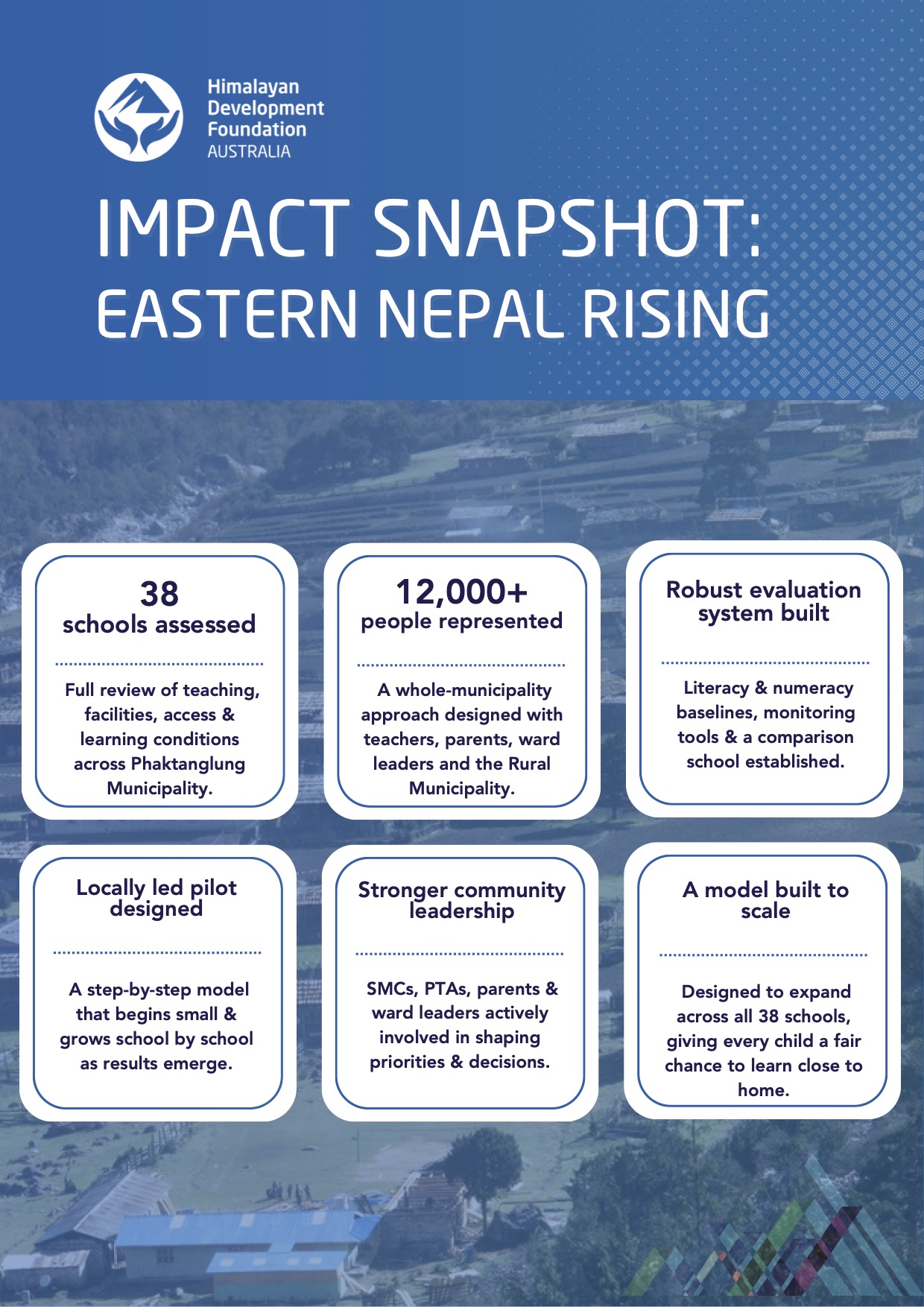
• First full review of all 38 schools completed
• Community priorities mapped with teachers, parents, SMCs and ward leaders
• Pilot design completed with HDFA, PHASE Nepal, KBSS, AHF and the Municipality
• Literacy and numeracy baseline framework established
• Comparison school identified
• Practical support package prepared for pilot schools
• Livelihood pathways aligned with AHF’s orchard and soil programs
• Municipal commitment secured for shared leadership and resourcing
• Children attending school more consistently despite monsoon disruption
• Teachers confident, supported and better equipped
• Safer, better-resourced classrooms
• Families with more stable food and income
• Young people accessing skills and pathways linked to local work
• A clear, locally led model that can scale across all 38 schools
• A generation of children able to learn, grow and imagine their future close to home
Impact Goals
• 38 schools engaged
• 1 pilot ready to launch
• 100+ teachers, SMCs and parents involved in planning
• 100+ farmers engaged in orchard/soil training
• 2,000 fruit and nut trees distributed across the region
• 1 local biofertiliser factory supporting soil health
• 1 municipality-wide literacy and numeracy baseline
• 1 world-leading model designed to grow valley by valley, ward by ward